On this page
Start with one round, not a list of moves.
Teen Patti in one minute
Teen Patti means three cards. In the standard version, each player receives three cards from a 52-card deck with the jokers removed. Players take turns deciding whether to continue or pack. A round ends when one player remains or an allowed show compares the final hands. Learn with practice counters.
Before dealing, agree the boot, turn order, maximum stake, sideshow conditions and Ace-sequence order. Apps and family tables can use different conventions; read the specific room rules.
A complete practice round
Seat three adult players and give each 30 practice counters. Set a boot of 1 counter each, making a starting pot of 3. Deal three face-down cards per player. The first player looks at their cards and is seen; another stays blind. Use the table’s announced stake rules as turns continue.
If one player packs and the final two agree to a permitted show, compare the hand categories first. A pair beats a high-card hand even if that high card is an Ace. The example counters serve as teaching aids.
Blind, seen, pack and show
Blind means playing before looking at your cards; seen means you have looked. Chaal is a move made at the applicable stake. Pack means leaving the round and giving up any claim to the current pot. Show is the final comparison when the table permits it.
A commonly used rule requires seen players to contribute twice the current blind stake. Limits, show costs and eligibility differ. Read the room rules before relying on this relationship; it is an example rather than a universal setting.
Six categories, one order
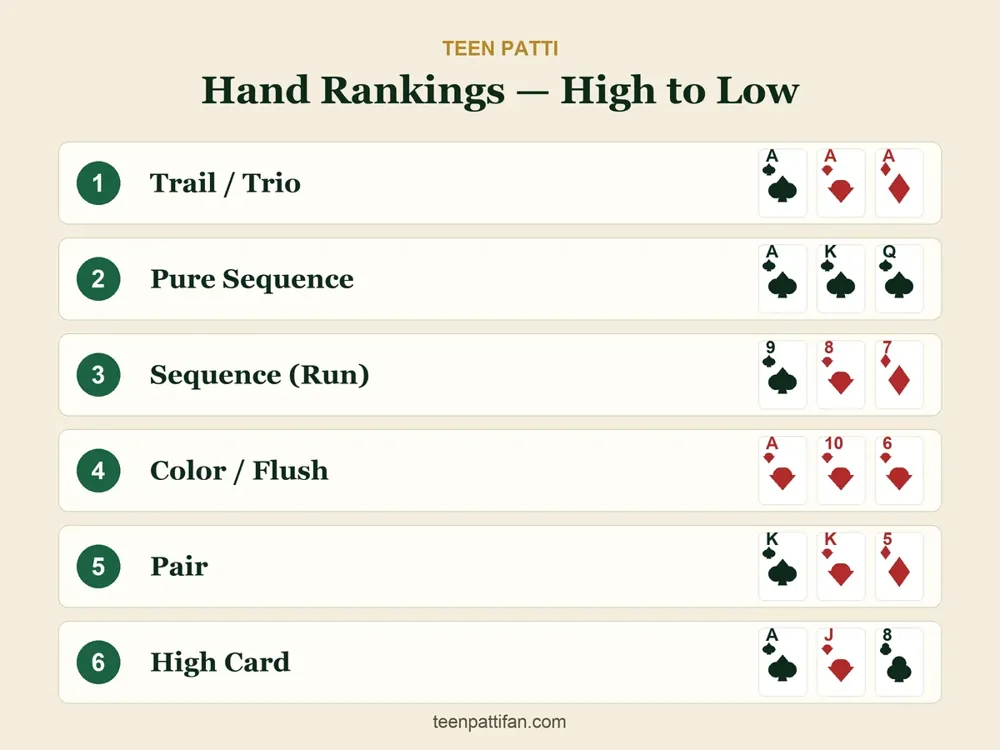
Compare category before individual ranks: Trail, pure sequence, sequence, color, pair, high card. A low sequence still beats a high color. Within a pair, compare the paired rank first and the unmatched card second. For equal ranks, apply the table’s published tie procedure.
The Ace rule to confirm first
A-K-Q and A-2-3 are both valid sequences in many rule sets, but their order varies. Even the publisher references linked below describe different Ace conventions. Ask whether A-2-3 ranks first, second or low before the first hand. Q-K-A is consecutive; K-A-2 belongs outside the ordinary sequence categories.
Beginner checklist
Read the ranking chart, practise five comparisons, and agree the room rules aloud. Set a session length before opening an app. The next deal remains a matter of chance. Use this guide to improve rule knowledge and decision awareness.
Follow the decision, then the comparison
| Stage | What to decide | What to read |
|---|---|---|
| Before dealing | Deck, boot, limits and Ace order | The room’s written convention |
| Your turn | Blind/seen status, continue or pack | Current minimum and maximum move |
| Comparison | Show or permitted sideshow | Eligibility, consent and tie procedure |
| Hand result | Category, then applicable ranks | Pair kicker and Ace profile when relevant |
Keep the two kinds of knowledge together: a hand chart explains comparisons; a room rule sheet explains which action is available. A strong category and an eligible action are separate checks.
A useful five-hand practice session
Deal two open hands five times. On the first deal, name each category. On the second, explain why a low pair outranks Ace-high. On the third, compare equal pairs with different kickers. On the fourth, choose an Ace profile for A-K-Q versus A-2-3. On the fifth, read the room’s equal-hand procedure.
Use the comparison tool for repeatable examples, follow the Hinglish lesson, or choose the next topic. Practise with counters, set a session length and take breaks.
Put this lesson into practice
Choose one example from the page and explain the rule before revealing the answer. Change one card and compare the result. Keep the deck, Ace convention and room-specific conditions together whenever you apply a chart.
Use the Hand Lab for standard Teen Patti comparisons or follow the Rummy Room for 13-card grouping lessons. Learn with practice counters, a planned session and regular breaks.
Source references
Rule references identify the convention described by the publisher. File and product records retain their own source scope.