On this page
A pure sequence is the natural starting point for a Rummy hand: consecutive cards in one suit, using their own ranks.
What makes a pure sequence?
A pure sequence uses at least three consecutive cards of the same suit in their natural positions. 4♥ 5♥ 6♥ qualifies. 4♥ 5♣ 6♥ has mixed suits and belongs outside that grouping. 4♥ 6♥ 7♥ has a gap.
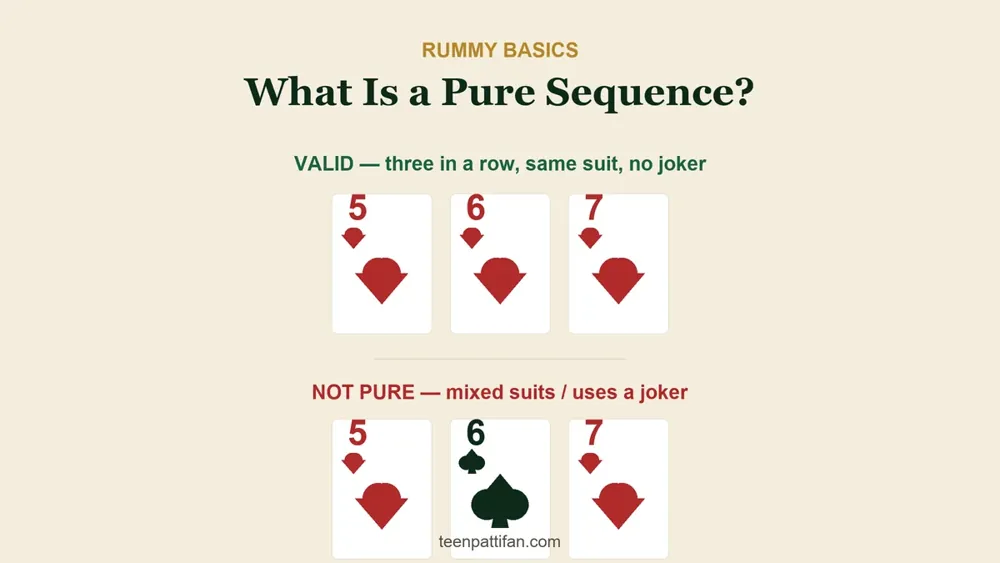
Pure versus impure
4♥ 5♥ 6♥ is pure. 4♥ Joker 6♥ can be impure when the joker substitutes for 5♥ under the table’s rule. A printed joker and a card of the selected wild rank may be treated differently. A wild-rank card used at its natural position can be allowed in a pure sequence by some rule sets; confirm this explicitly.
Three groups to check
7♣ 8♣ 9♣ is a sequence. Q♠ Q♥ Q♦ is a set. J♦ Q♦ K♦ is a sequence. Aces can be low in A-2-3 or high in Q-K-A in common formats; ordinary Ace sequences place the Ace at an end.
A declaration checklist
First locate one pure sequence. Then find the second required sequence, which may be pure or impure according to the room. Check the rest of the hand and count 13 cards. Complete every required group and count all 13 cards before declaring.
Inspect the group one feature at a time
| Cards | What the group shows | Next check |
|---|---|---|
| 4♥ 5♥ 6♥ | One suit and consecutive natural ranks | Pure sequence under the stated convention |
| 4♥ 5♣ 6♥ | Consecutive ranks with mixed suits | A Rummy sequence requires the same suit |
| 4♥ 6♥ 7♥ | One suit with a rank gap | Account for the missing position under the room rule |
| Q♠ Q♥ Q♦ | Matching ranks in different suits | A set, with a different role from a sequence |
A wild-rank card in its natural position
Purity depends on how the card is used and on the room’s definition. A wild card used to fill a missing rank is a substitution. Some rule sets also explain when a selected wild-rank card can retain its natural identity. Read that distinction explicitly before deciding whether the group supplies the required pure sequence.
Finish with a whole-hand check
Locate the pure sequence, locate the second required sequence, inspect every remaining group and count 13 cards. Check minimum run lengths and the permitted joker usage. Then review the final declaration screen deliberately.
The complete Rummy guide provides a 13-card example, and the declaration guide separates grouping from scoring. Use the learning path to continue one topic at a time.
Put this lesson into practice
Choose one example from the page and explain the rule before revealing the answer. Change one card and compare the result. Keep the deck, Ace convention and room-specific conditions together whenever you apply a chart.
Use the Hand Lab for standard Teen Patti comparisons or follow the Rummy Room for 13-card grouping lessons. Learn with practice counters, a planned session and regular breaks.
Source references
Rule references identify the convention described by the publisher. File and product records retain their own source scope.