On this page
Think of a Rummy declaration as a card-counting exercise.
The basic objective
In a common 13-card Indian Rummy format, arrange all 13 cards into valid sequences and sets. A valid declaration commonly needs at least two sequences, including one pure sequence. Rules differ by format, so confirm the room’s declaration and scoring conditions.
One turn at a time
On your turn, draw one card from the permitted pile, decide how it helps your groups, and discard one card. The normal hand returns to 13 cards after discarding. Keep planned groups separate and check the selected card before each discard.
A valid example to inspect
3♥ 4♥ 5♥ / 7♣ 8♣ 9♣ / K♠ K♥ K♦ / 2♠ 3♠ 4♠ 5♠ uses 13 cards in four groups. It has three pure sequences and one set. This is a teaching example for a standard declaration rule; the room’s rules specify how duplicates and jokers are treated.
Sequences and sets are different
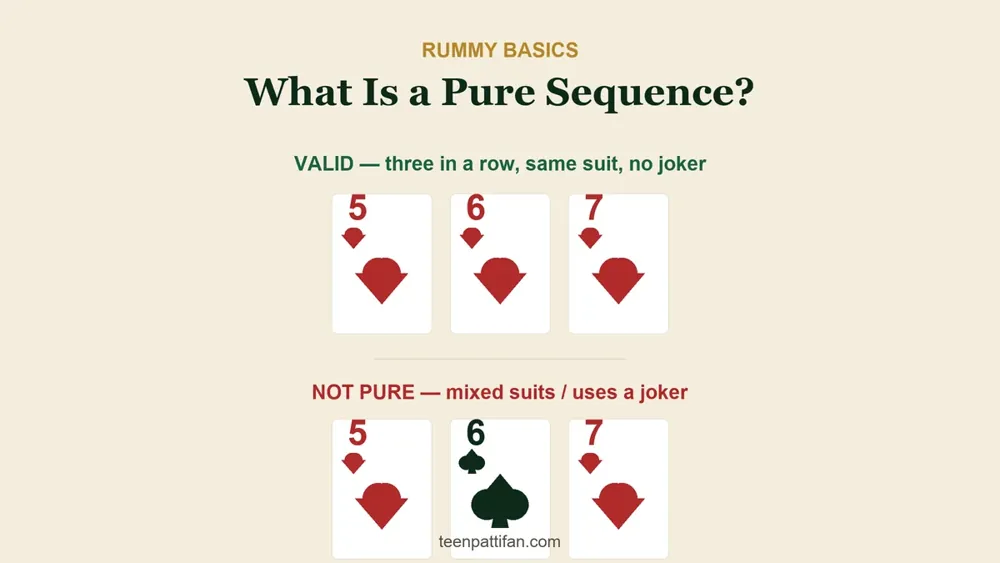
A sequence uses consecutive ranks in the same suit. A set uses matching ranks in different suits. Rummy sequences share one suit; Teen Patti also recognises a mixed-suit sequence category. A pure sequence uses cards at their natural ranks and positions.
Before pressing declare
Count all 13 cards, verify the pure sequence, verify the second sequence and inspect every remaining group. Check the app’s confirmation screen carefully. A hand that looks tidy can still be invalid if one group has duplicate suits or a gap.
Learn with practice counters
Use physical cards or a clearly described practice mode. Points, pool and deals formats use different scoring structures. Read the legal classification alongside a game’s skill components.
A draw-and-discard check
Start a normal turn with 13 cards. Drawing gives one extra card to consider; discarding returns the hand to 13. Check the selected discard against your planned pure sequence before confirming. Recount after moving a card between groups so every card has a clear role.
| Group | Cards | Check |
|---|---|---|
| Pure sequence | 3♥ 4♥ 5♥ | Natural consecutive ranks, one suit |
| Second sequence | 7♣ 8♣ 9♣ | Same-suit consecutive group |
| Set | K♠ K♥ K♦ | Equal ranks, distinct suits |
| Four-card sequence | 2♠ 3♠ 4♠ 5♠ | All four fit the same run |
Read the room’s extra requirements
A rule sheet can add conditions beyond the basic grouping summary. Octro’s published FAQ describes a four-card minimum for one of the two required runs and its own wild-card limit. Other formats publish their own convention. Connect the sample declaration to the room you are actually reading.
For the next lesson, choose pure-sequence checks, declaration and scoring, or pool scoreboards. The Rummy learning path keeps these topics in order.
Put this lesson into practice
Choose one example from the page and explain the rule before revealing the answer. Change one card and compare the result. Keep the deck, Ace convention and room-specific conditions together whenever you apply a chart.
Use the Hand Lab for standard Teen Patti comparisons or follow the Rummy Room for 13-card grouping lessons. Learn with practice counters, a planned session and regular breaks.
Source references
Rule references identify the convention described by the publisher. File and product records retain their own source scope.